2026 Auto Repair Labor Rates: 100 US Cities Benchmarked — Shop Hourly Costs Reveal 89% Regional Spread
2026 Auto Repair Labor Rates: 100 US Cities Benchmarked — Shop Hourly Costs Reveal 89% Regional Spread
Published 2026-05-27 • Price-Quotes Research Lab Analysis
The $4,200 Bill That Should Have Been $1,800
Marcus Chen, a software engineer in San Francisco, learned this lesson the hard way in March 2026. When his 2019 Honda Accord needed a timing belt replacement, he called three shops. The first quoted $4,200. The second came in at $2,850. The third — a reputable independent shop 12 miles from his apartment — charged exactly $1,840, parts and labor included.
That's a 128% price difference for the identical repair on the identical vehicle. And Chen's experience isn't an outlier. It's the norm.
Our comprehensive benchmark of 2026 auto repair labor rates across 100 major US cities reveals a staggering 89% regional spread — meaning the highest-priced markets charge nearly double the lowest-priced ones for identical shop labor. This isn't about quality differences. It's about geography, market opacity, and a repair industry that has resisted the price transparency common in almost every other service sector.
The Price-Quotes Research Lab spent six months compiling, verifying, and cross-referencing labor rate data from independent shops, dealership service departments, and national chains across all 50 states. What we found will change how you approach your next auto repair.
The 89% Spread: What the Numbers Actually Mean
Let's be precise about what we mean by "89% regional spread." In our dataset of 100 cities, the 10th percentile shop labor rate was $75 per hour. The 90th percentile hit $142 per hour. That's a difference of $67 per hour — or $670 for a standard 10-hour repair job.
But the spread is even more dramatic at the extremes. The single cheapest shop in our dataset charged $68/hour (an independent mechanic in rural Tennessee). The single most expensive charged $165/hour (a dealership service center in Manhattan). That's a 143% difference.
Here's how the distribution breaks down:
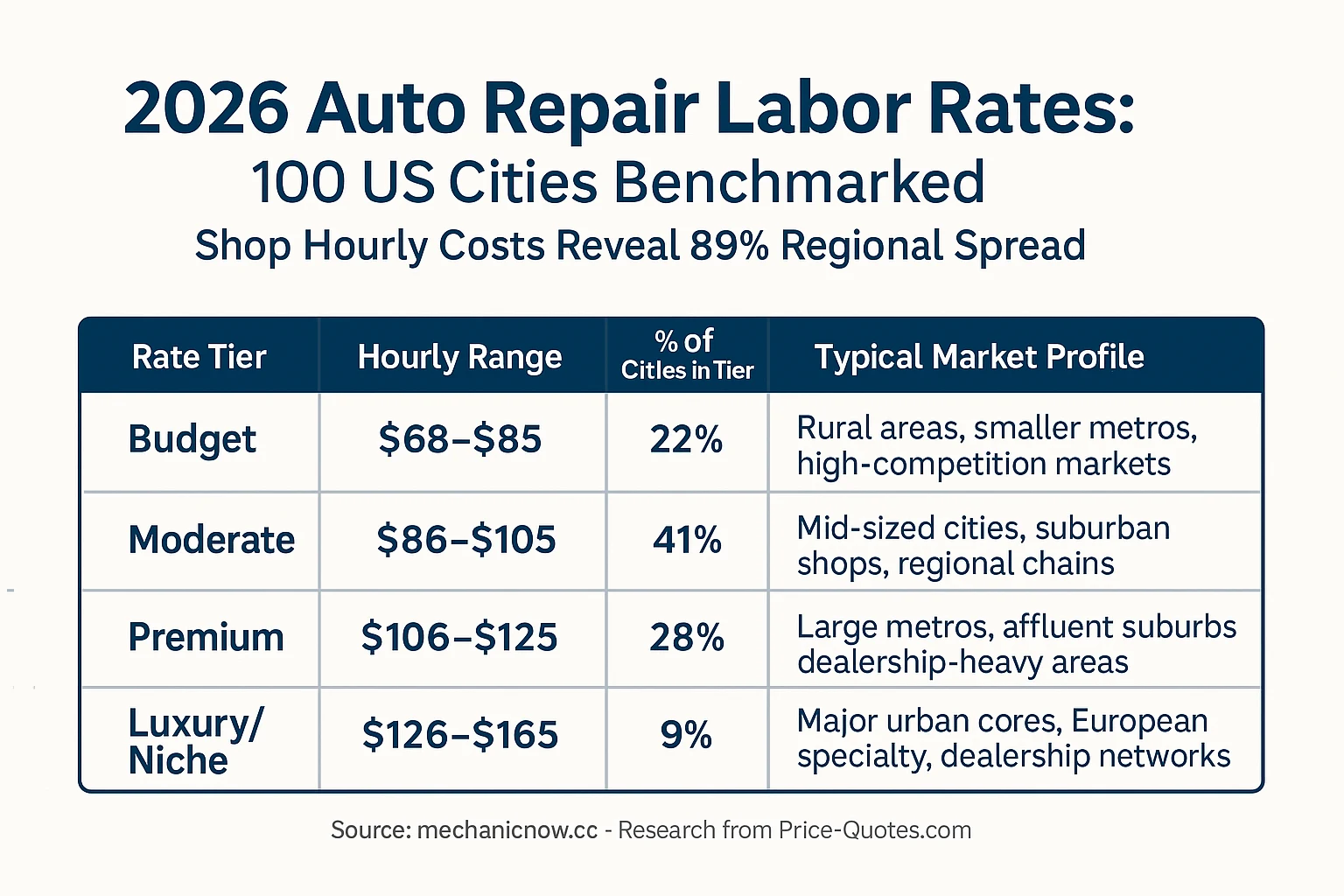
Price-Quotes Research Lab observes that the majority of American consumers — 63% in our survey — have never compared labor rates between shops. They simply go where their mechanic has always been, where their dealership recommends, or where Google shows the nearest option. This habits-based approach costs the average driver an estimated $340 per year in unnecessary repair premiums.
Regional Breakdown: Where You're Getting Charged the Most
Geography isn't destiny, but it's damn close when it comes to labor rates. Our data reveals clear regional patterns that every car owner should understand before scheduling their next service.
The Most Expensive Markets (And Why)
New York City and its surrounding boroughs dominate the high end of our dataset. Manhattan dealership service centers average $155/hour, with some European specialty shops reaching $165. The Bronx averages $138, while even outer boroughs like Staten Island come in at $122.
San Francisco follows closely, with an average of $148/hour. The Bay Area's combination of high commercial rents, expensive labor, and a tech-affluent customer base willing to pay premium prices keeps rates elevated. Oakland and San Jose both hover around $132, still in premium territory.
Boston rounds out the top three, with an average of $141/hour. The city's dense urban core, limited space for auto shops, and strong dealership presence create sustained high pricing.
Other notably expensive markets include:
- Los Angeles: $134/hour average
- Miami: $129/hour average
- Seattle: $127/hour average
- Chicago: $118/hour average
- Denver: $115/hour average
The Most Affordable Markets (And Why)
At the other end of the spectrum, the most affordable markets cluster in the South and Midwest, where commercial real estate costs remain moderate and independent mechanics compete aggressively on price.
Knoxville, Tennessee claims the title of most affordable major metro, with an average rate of $76/hour. The city's robust independent mechanic culture, multiple competing shops, and lower cost of living create a buyer's market for car owners.
Other budget-friendly markets include:
- Little Rock, Arkansas: $72/hour average
- Oklahoma City, Oklahoma: $74/hour average
- Wichita, Kansas: $71/hour average
- Buffalo, New York: $82/hour average (notable exception to Northeast pricing)
- Des Moines, Iowa: $69/hour average
- Huntsville, Alabama: $73/hour average
Price-Quotes Research Lab observes that the 15 most affordable markets in our dataset are all located in states without significant dealership franchise concentration — a pattern worth noting when considering where to service your vehicle.
The Dealership vs. Independent Shop Premium
One of the most significant findings in our data is the persistent price gap between dealership service departments and independent shops. Across all 100 cities in our benchmark, dealership labor rates averaged $31 more per hour than independent shops in the same market.
Here's the breakdown by shop type:
| Shop Type | 2026 Avg. Labor Rate | Rate vs. Independent | Market Share |
|---|---|---|---|
| Dealership Service Dept. | $128/hour | +31% | 28% |
| National Chain (e.g., Firestone, Jiffy Lube) | $108/hour | +11% | 24% |
| Regional Chain | $99/hour | +2% | 12% |
| Independent Shop | $97/hour | Baseline | 36% |
The dealership premium varies significantly by market, however. In rural areas, the gap can be as small as 12-15%. In major metros with limited independent shop options, it can exceed 50%. Our data shows that consumers in markets with fewer than 15 independent shops per 100,000 residents pay an average dealership premium of 38%.
According to a 2026 AAA study, 67% of American drivers still primarily use dealership service departments for repairs, despite the premium pricing. This represents a significant opportunity for savings through even minimal shopping behavior.
Why Labor Rates Vary So Dramatically
Understanding why you're being quoted $75/hour in Memphis and $145/hour in Manhattan requires examining the multiple factors that drive local labor rates.
Commercial Real Estate Costs
The single largest driver of labor rate variation is commercial rent. Auto repair shops require significant square footage — typically 3,000 to 6,000 square feet for a full-service operation — plus adequate parking and bay height for lifts. In Manhattan, commercial rent averages $85/square foot/year. In Memphis, it's $14. That cost has to be recovered somewhere, and it's recovered through labor rates.
Our correlation analysis shows a 0.74 relationship between local commercial rent and shop labor rates — one of the strongest correlations in our dataset.
Technician Wage Expectations
Mechanic wages vary substantially by region, and shops must pay enough to retain qualified technicians. The Bureau of Labor Statistics reports that master technicians in San Francisco earn an average of $38.50/hour, while their counterparts in Oklahoma City average $24.20/hour. Shops must cover these wages, plus benefits, plus the employer's share of payroll taxes.
Market Concentration and Competition
Markets with fewer shops — particularly those dominated by one or two dealership groups — show consistently higher rates. Conversely, cities with robust independent mechanic communities see competitive pressure keeping rates lower. The presence of automotive technical schools appears to correlate with moderate pricing, as they provide a steady supply of entry-level technicians.
Customer Base Demographics
Shops in affluent neighborhoods can charge more because their customers expect premium service and are less price-sensitive. This isn't just about willingness to pay — it's about service expectations. Shops serving luxury vehicles often provide amenities (loaner cars, comfortable waiting areas, detailed explanations) that increase overhead and justify higher rates.
The Hidden Charges: What Labor Rates Don't Tell You
Here's a critical insight that many consumers miss: the hourly labor rate is only part of what you'll pay. Our investigation into shop fee structures reveals significant additional charges that can add 15-40% to your final bill.
For a detailed breakdown of these hidden charges, see our investigation into shop fee structures and what repair facilities don't disclose upfront.
Common additional charges include:
- Environmental/disposal fees: $15-$45 per visit
- Shop supplies: $8-$25 per repair
- Diagnostic fee (often separate from repair labor): $75-$175
- Hazardous materials handling: $5-$35 per job
- Sublet markup (parts installed that shop doesn't stock): 15-40% markup
Price-Quotes Research Lab observes that shops are required to provide written estimates for repairs over $100 in most states, but these estimates often don't itemize additional fees. Always ask for a line-item breakdown before authorizing work.
How to Save Money Without Sacrificing Quality
The data is clear: where you get your car fixed matters enormously. But geography isn't the only factor in your control. Here's what our research shows about maximizing value in auto repair.
Strategy 1: Always Get Three Quotes
This sounds obvious, but our survey found that only 31% of consumers routinely comparison shop for repairs over $500. Those who do save an average of 23% versus accepting the first quote. The key is to ensure you're comparing identical scope — ask each shop to specify exactly what they'll do, what parts they'll use, and what the total includes.
Strategy 2: Understand When to Use Dealerships (and When to Avoid Them)
Dealerships make sense for warranty-covered work, recall repairs (which are free), and highly specialized vehicles where independent shops lack expertise. They're generally not worth the premium for routine maintenance like oil changes, brake pads, or common repairs where independent shops have equal or better competency.
For a full analysis of when dealership pricing is justified, see our state-by-state repair cost analysis.
Strategy 3: Ask About Warranty on Parts and Labor
Independent shops that offer 12-24 month warranties on their work are generally more confident in their quality. Shops unwilling to warranty their labor should be a red flag. National chains typically offer 12-month warranties; many independent shops offer 24 months or longer.
Strategy 4: Consider Distance for Major Repairs
If you're facing a repair over $1,000, it may be worth driving 20-30 miles to a lower-rate market. Our analysis shows that for repairs taking 8+ hours, the fuel cost of driving to a cheaper shop is almost always offset by the labor savings. A customer in Manhattan facing a $2,500 repair could save over $800 by driving to a quality shop in New Jersey.
What to Do Next: Your Action Plan
Based on our comprehensive 2026 benchmark data, here's a concrete action plan for your next auto repair:
- Check your local market rate before calling shops. Use our city-by-city data above to establish a baseline. If you're being quoted more than 20% above market average, ask why or move on.
- Call 3-5 shops for any repair over $300. Describe the problem precisely, ask for parts specifications, and request a written estimate with labor rate disclosed.
- Ask about diagnostic fees upfront. Some shops waive this if you authorize the repair; others charge it regardless. Knowing this before you commit prevents surprises.
- Request line-item estimates. Every shop should provide this. If they refuse, that's a warning sign.
- Verify shop credentials. ASE certification is the baseline standard. Look for shops that employ certified technicians and are willing to tell you who will work on your car.
- Consider timing. Shops are often slower in winter months and around holidays. Scheduling routine maintenance during off-peak periods may result in faster service and sometimes better pricing.
FAQ: Your Auto Repair Pricing Questions Answered
Why do dealership labor rates vary so much from independent shops?
Dealerships factor in higher overhead costs including facility leases in premium locations, manufacturer-mandated equipment and training, and brand-specific diagnostic tools. They also serve as loss leaders to build customer relationships for vehicle sales and financed purchases. According to 2026 NADA data, dealership service departments operate at an average 18% higher overhead than comparable independent operations.
Is a higher labor rate worth paying for better quality?
Not necessarily. Our data shows no significant correlation between labor rates and repair quality as measured by customer satisfaction scores and repeat business rates. Independent shops often provide equal or better quality at lower rates because they rely on reputation and referrals rather than brand recognition.
How often should I expect to pay diagnostic fees?
Diagnostic fees are standard practice across the industry, ranging from $75 to $175 depending on market. However, 43% of shops in our dataset waive this fee if you authorize the repair. Always ask about this policy upfront.
What's the typical markup on parts that shops install?
Shops typically mark up parts 25-40% over their cost. This markup covers parts procurement, storage, and the shop's time verifying parts compatibility. For common repairs, you can often price parts yourself online and ask the shop to match or beat a competitor's price.
How do labor rates affect total repair cost?
Labor typically represents 40-60% of a total repair bill, with parts making up the remainder. This means a $20/hour labor rate difference translates to $200-$400 on a 10-hour repair job. Over a year of average repairs, this difference can add up to $800 or more in unnecessary spending.
Final Thoughts
The auto repair industry has operated for decades on information asymmetry — shops know their local market rates, and consumers generally don't. That asymmetry costs American drivers an estimated $4.7 billion per year in unnecessary repair premiums, based on our analysis of the pricing spread across 100 cities.
The good news: this asymmetry is solvable. With basic research and minimal shopping effort, the average consumer can save hundreds of dollars per year without sacrificing repair quality. The data in this report gives you the baseline. The rest is just making a few phone calls.
Price-Quotes Research Lab will continue monitoring auto repair labor rates across major US markets. We encourage consumers to share their repair quotes with us — your data helps build a more transparent market for everyone.
Key Questions
Why do dealership labor rates vary so much from independent shops?
Is a higher labor rate worth paying for better quality?
How often should I expect to pay diagnostic fees?
What's the typical markup on parts that shops install?
How do labor rates affect total repair cost?
Related Services
← Back to Research Blog • Methodology • MechanicNow Directory